I suppose that at the end of the day, there is no such thing as bad or good metalwork (except, in some cases.) The best way to explain this is through cars... Everyone understand cars.
A Honda Civic is a very good car. A Maserati (just throwing out one everyone is familiar with) is also great car. Both are owned by people with great taste.
Now, I might be presumptuous here, but add the means to the taste, and from the choices above, most of us would be driving around town in the Maserati. All you have to do is look at the two next to each other and you'll feel the difference.
Same applies to metalwork.
I will be the first to say that I can not afford the metalwork I design and desire, but have a great appreciation for the skill it takes to make it and the feeling it gives me to see true beauty. This is why I love getting a new house, new style, new set of challenges to work on. I treat each project as if it was my very own, and always strive for it to reach its full potential. It drives me sooo crazy when I see a beautiful home filled with less then worthy of stair railings, chandeliers, doors, drive gates and so on.
For the most part, I can't blame the owners of the homes, as they are simply used to seeing the above described metalwork all around them, and simply don't realize that there is something which is worthy of being called an heirloom of the future; an antique. Not to mention that so many metal shops carelessly throw around labels such as "the finest", "hand wrought", and "attention to detail." Words like this should be chosen carefully; at least in my opinion.
This weekend, I will organize some photos so that I can visually explain the difference in metalwork, and true beauty.
***For more information on my designs and the ornamental ironwork and lighting our metalworkers fabricate right here in Dallas, Texas go to www.potterartmetal.com

Mold Making
I had a question recently on the process of mold making.

Here is the most easy and painless way to make them: Go Talk To My Buddy Mitch Rogers!
He's the most sweet guy you'll ever meet and is super helpful. On top of it, he can explain to you exactly what materials to use for what job and so on. Mitch was actually nice enough to help me out with my Henry The Tortoise. I sculpted him and Mitch helped me with the mold, since I decided to do that on my own instead of hiring a professional mold maker. BITY (short of Brick In The Yard: his Mold Supply Company) has tons of options. With all the options it's very easy to get super confused, but I promise he'll talk you right through it all.
There are lots of different types of Molds (or Moulds) out there, but for our purposes, we'll stick with what I do.
For me, a mold is a some sort of a rubber or silicone, which is in a liquid form and usually contains two parts. When the two parts are mixed, the material can easily be applied with a brush onto a sculpted piece we want to cast in metal or plastic, or what ever else you desire.
It's much more complicated then this of course. There are the obvious issues with, lets say, a brushed on rubber mold: Take it off the turtle and the mold will flop. To fix this pesky problem you'll have to build a mother mold on top of your rubber mold. A mother mold is built from something that will turn hard, and therefore will be able to support the shape of the floppy rubber mold. I like to use a two part hard plastic or foam, or even plaster.
Another problem with a sculpture like Henry is that he's quite intricate... you can't just pull the mold off a piece like that. So what can be done about that? Well, the mold and mother mold will have to be engineered in parts which will be able to pull apart, but also stay together tightly for when you are ready to paint in the wax for the metal foundry or pur in some plastic for other purposes.
I'm sure your head hurts by now, so I suggest watching a few BITY videos... they'll greatly help you in your understanding of the process. I'm going to plug in a few below, but he's got many more you can check out on YouTube. If you have any questions, I'll try to help out.
Wrought vs. Cast
I live a dual art metal life... at Potter Art Metal Studios I work with Wrought Metal, and in my personal time I work with Cast Metal.
I always get this question: So what's the difference?
Here is the short and sweet version:
Wrought simply means that a piece of metal, usually a square or round bar or plate, is shaped by being hit with a hammer. In the case of wrought iron, the metal is usually placed in the forge until it's red hot so that it can be pliable. This is what we do at Potter Art Metal Studios. Via this process our artisans forge pieces and make chandeliers, fandeliers, lanterns, drive gates, table bases, window grilles, decorative hinges, doors, and many, many, more pieces designed by myself or other designers. The cool thing is that it's all custom, and therefore can be made into exactly what the client's dreams are. {I will explain the different forging techniques in my next post.}
***For more information on my designs and the ornamental ironwork and lighting our metalworkers fabricate right here in Dallas, Texas go to www.potterartmetal.com
I always get this question: So what's the difference?
Here is the short and sweet version:
Wrought simply means that a piece of metal, usually a square or round bar or plate, is shaped by being hit with a hammer. In the case of wrought iron, the metal is usually placed in the forge until it's red hot so that it can be pliable. This is what we do at Potter Art Metal Studios. Via this process our artisans forge pieces and make chandeliers, fandeliers, lanterns, drive gates, table bases, window grilles, decorative hinges, doors, and many, many, more pieces designed by myself or other designers. The cool thing is that it's all custom, and therefore can be made into exactly what the client's dreams are. {I will explain the different forging techniques in my next post.}
 |
| © All Rights Reserved |
As I mentioned earlier, my personal time is spent with metal casting. More accurately; creating my sculptures in clay, which is an important step in sand, spin, or lost wax casting.
The main difference in Wrought Metal and Casting is simple: casting is a process by which a metal such as bronze, iron, or aluminum has been melted down to a liquid, and then is forced into a mold (a negative of lets say a tortoise; an empty hole.) It's a great process... from my imagination, to clay, to a mold, a wax, to investment, to metal, to a bronze tortoise. And now you know! {I will explain what a mold is and the differences in the casting processes in the near future.}
 |
| © All Rights Reserved |
***For more information on my designs and the ornamental ironwork and lighting our metalworkers fabricate right here in Dallas, Texas go to www.potterartmetal.com
Dallas Home Design
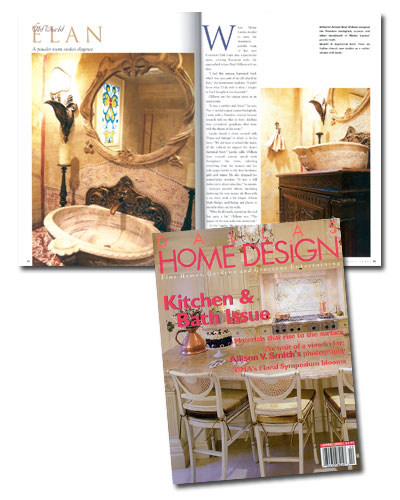
The good times working with Brad Oldham:) ]
Dallas Modern Luxury
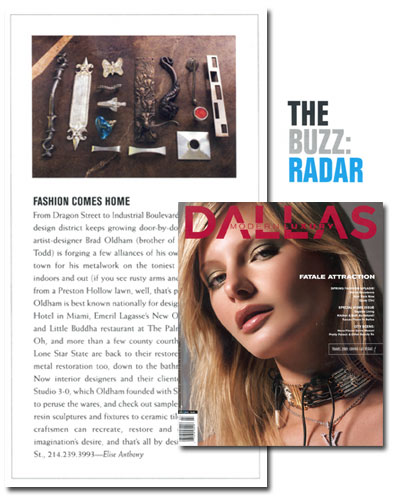
The two door hardware pieces directly to the right of the Dallas Modern Luxury Magazine cover were sculpted by me. One is a bronze door back plate , with a herd of elephants sculpted on it; the head of the elephant on in front of the line is comes out and his trunk turns into the door lever. The piece next to that is a door pull, which looks like a Griffin.
F|D Luxe: Local Color
FD Luxe (Dallas Morning News)- published October 01, 2010
Local color
FROM THE REVIVAL OF A HISTORIC MINERAL WELLS HOTEL TO A DESIGN-OBSESSED DALLAS BLOGGER'S LATEST FAVES, WE'VE GOT THE INSIDE LINE
BY KRISTIE RAMIREZ
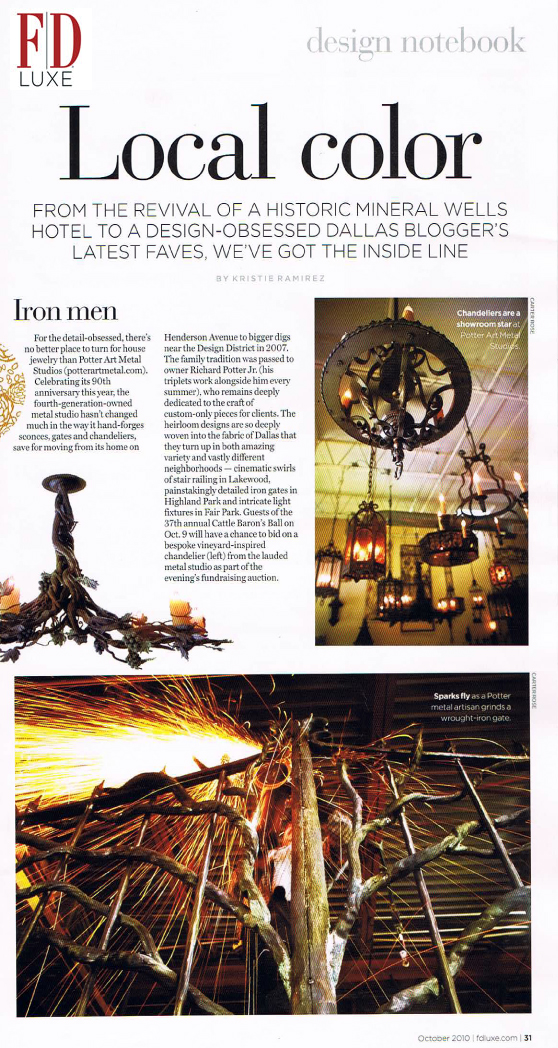 Iron men For the detail-obsessed there's no better place to turn for house jewelry then Potter Art Metal Studios (potterartmetal.com). Celebrating its 90th anniversary this year, the fourth-generation-owned metal studio hasn't changed much in the way it hand-forges sconces, gates and chandeliers, save for moving from its home on Henderson Avenue to bigger digs near the Design District in 2007. The family tradition was passed to owner Richard Potter Jr. (his triplets work alongside him every summer), who remains deeply dedicated to the craft of custom-only pieces for clients. The heirloom designs are so deeply woven into the fabric of Dallas that they turn up in both amazing variety and vast in different neighborhoods - cinematic swirls of stair railing in Lakewood, painstakingly detailed iron gates in Highland Park and intricate light fixtures in Fair Park. Guests of the 37th annual Cattle Baron's Ball on Oct. 9 will have a chance to bid on a bespoke vineyard-inspired chandelier (left) from the lauded metal studios as part of the evening's fundraising auction.
(A little PS. This is really neat. There is an article on the next page, The fabulous Baker reborn, which talks about the 80 year old Baker Hotel in Mineral Wells which is going to be renovated. Anyway, they talk about the Stoneigh Hotel in Dallas which was also renovated by Jeff Trigger... so the neat part is that Richard's grandfather originally did the metalwork for it and the Baker Hotel in Dallas (not sure about the Mineral Wells one)... and we recently re-furbished the Stoneligh Hotel Metalwork and added another stair rail section to it. Just a bit of neat!)
Potter Art Metal Studios celebrates 90 years of providing jewelry for the home
Thursday, July 1, 2010
Park Cities News
Potter Art Metal Studios celebrates 90 years of providing jewelry for the home
Potter Art Metal Studios is proudly celebrating 90 years of making custom creations in metal. Designers and fabricators of ornamental metalwork and lighting, their work graces high-end residential and commercial projects, as well as municipal buildings and churches around the country. Potter is one of the oldest metal studios in Dallas and the southwest and produces 'functional art' destined to become heirlooms, including architectural, lighting, furnishings or other products fashioned from steel, brass, bronze, copper and aluminum.
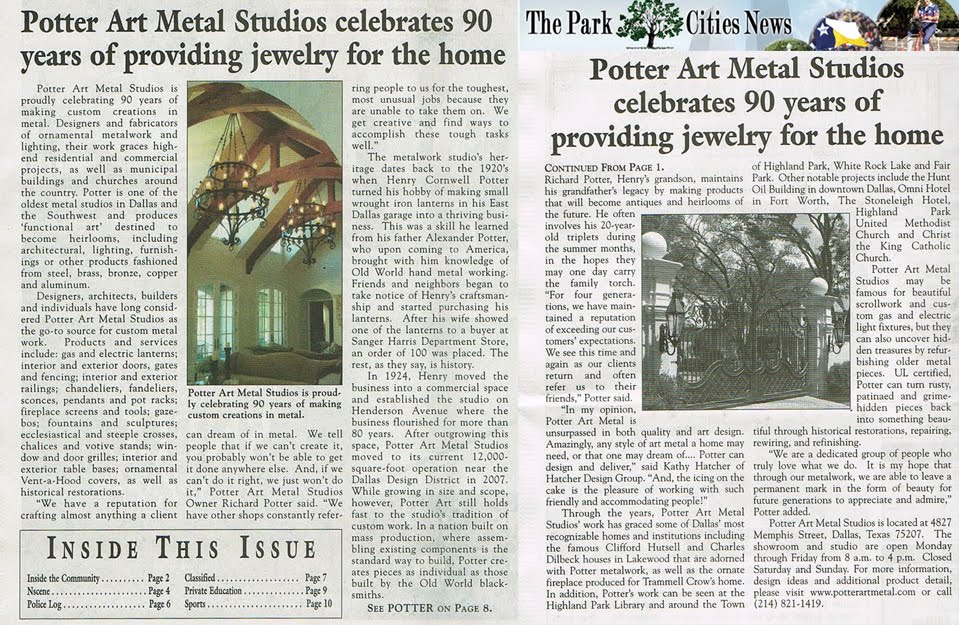 Designers, architects, builders and individuals have long considered Potter Art Metal Studios as the go-to source for custom metal work. Products and services include: gas and electric lanterns; interior and exterior doors, gates and fencing; interior and exterior railings; chandeliers, fandeleirs, sconces, pendants and pot racks; fireplace screens and tools; gazebos; fountains and sculptures; ecclesiastical and steeple crosses, chalices and votive stands; window and door grilles; interior and exterior table bases; ornamental Vent-aHood covers, as well as historical restorations.
"We have a reputation for crafting almost anything a client can dream of in metal. We tell people that if we can't create it, you probably won't be able to get it done anywhere else. And, if we can't do it right, we just won't do it," Potter Art Metal Studios Owner Richard Potter said. "We have other shops constantly referring people to us for the toughest, most unusual jobs because they are unable to take them on. We get creative and find ways to accomplish these tough tasks well."
The metalwork studio's heritage dates back to the 1920's when Henry Cornwell Potter turned his hobby of making small wrought iron lanterns in his East Dallas garage into the thriving business. This was a skill he learned from his father Alexander Potter, who upon coming to America, brought with him knowledge of Old World hand metal working. Friends and neighbors began to take notice of Henry's craftsmanship and started purchasing his lanterns. After his wife showed one of the lanterns to a buyer at Sanger Harris Department Store, an order of 100 was placed. The rest, as they say, is history.
In 1924, Henry moved the business into a commercial space and established the studio on Henderson Avenue where the business flourished for more then 80 years. after outgrowing this space, Potter Art Metal Studios moved to its current 12,000-square-foot operation near the Dallas Design District in 2007. While growing in size and scope, however, Potter Art Metal still holds fast to the studio's tradition of custom work. In a nation built on mass production, where assembling existing components is the standard way to build, Potter creates pieces as individual as those built by the Old World blacksmiths.
Richard Potter, Henry's grandson, maintains his grandfather's legacy by making products that will become antiques and heirlooms of the future. he often involves his 20-year-old triplets during the summer months, in the hopes they may one day carry the family torch. "For four generations, we have maintained a reputation of exceeding our customers' expectations. We see this time and again as our clients return and often refer to us as their friends," Potter said.
"In my opinion Potter Art Metal is unsurpassed in both quality and art design. Amazingly, the style of art metal a home may need, or that one may dream of... Potter can design and deliver," said Kathy Hatcher of hatcher Design Group. "and, the icing on the cake is the pleasure of working with such friendly and accommodating people!"
Through the yars, Potter Art Metal Studios' work has graced some of Dallas' most recognizable homes and institutions including the famous Clifford Hutsell and Charles Dilbeck houses in Lakewood that are adorned with Potter metalwork, as well as the ornate fireplace produced for Trammell Crow's home. In addition, Potter's work can be seen at the Highland Park Library and around the Town of Highlahd Park, White Rock Lake [and Fair Park [light fixtures at the Hall of State]. Other notable projects include the Hunt Oil Building in down town Dallas, Omni Hotel in Fort Worth, The Stoneleigh Hotel, Highland Park United Methodist Church and Christ The King Catholic Church.
Potter Art Metal Studios may be famous for beautiful scrollwork and custom gas and electric light fixtures, but they can also uncover hidden treasures by refurbishing older metal pieces. UL certified, Potter can turn rusty, patinad pieces back into something beautiful through historical restorations, repairing, rewiring, and refurbishing.
We are a dedicated group of people who truly love what we do. It is my hope that through our metalwork, we are able to leave a permanent mark in the form of beauty for future generations to appreciate and admire," Potter added.
Potter Art Metal Studios is located at 4827 Memphis Street, Dallas, Texas 75207. The showroom and studios are open Monday through Friday from 8 a.m. to 4 p.m. Closed Saturday and sunday. For more information, design ideas and additional product detail, please visit www.potterartmetal.com or call (214) 821-1419.
Subscribe to:
Posts (Atom)